
Myth 7
Lab-grown diamonds are not better for the environment.
Truth
“if the battles will be played on ecological fields, ‘natural diamonds’ have practically no chances.”Sergey Goryainov, Rough & Polished, 15 June 2020
The lab grown diamonds from the leading producers in the world are today created with zero-emission energy, with a “real zero” carbon footprint. There is no mining operation that can get even close to achieving this.
Mining disturbs land, habitats and water systems. Much of the worst Diesel energy is used to mine diamonds – and a lot of it. Extracting diamond from earth using mining uses up to ten times as much energy as producing diamond in a lab.
Growing a diamond does use electricity but the largest diamond growers now have ever more energy efficient equipment – ten times better than just several years ago – and are using zero-emission energy for a zero carbon footprint.

Image: Diamond Foundry’s Wenatchee, USA diamond growing lab is situated in America’s apple orchard capital and powered 100% by the energy from the Columbia River.
Creating Diamonds Aboveground Takes Much Less Energy, Less Water
Conventional wisdom would suggest that creating a diamond aboveground takes a lot more energy than extracting an underground diamond that Earth has already created.
After all, diamond is created using intense amounts of temperature or pressure — so once formed, it should not take so much energy to harvest it.
It turns out it takes an entire factor more energy to extract an underground diamond from Earth than it takes to create one aboveground in a foundry.
On top of this, the energy used in mining is generally dirty Diesel versus renewable energy in our above-the-ground production.
The amount of energy required for underground mining is somewhat surprising — and a testament to how far innovation in aboveground diamond production technology has progressed over the years as well as how inefficient mining of underground diamonds tends to be, having to move huge quantities of soil in often highly remote areas.
Natural diamond mining is easily ten times worse than technological production just based on raw numbers -- and cannot compete with the zero carbon footprint achieved by leaders in technological innovation through 100% use of renewable energy.
The Facts: kWh per Carat Consumption is Much Lower for Lab Grown
Diamond mines operated by De Beers consume an average of 80.3 kWh per rough carat. The Canadian Diavik mines consume 66 kWh per rough carat. [1, 2, 3]
Each of these is an entire factor higher than what creating a diamond in a laboratory takes using the best available modern technology.
Diamond-growing technology has come a long way from its early days. Unlike mining technology, diamond-growing technology is on a semiconductor technology curve, with improvements happening every single quarter.
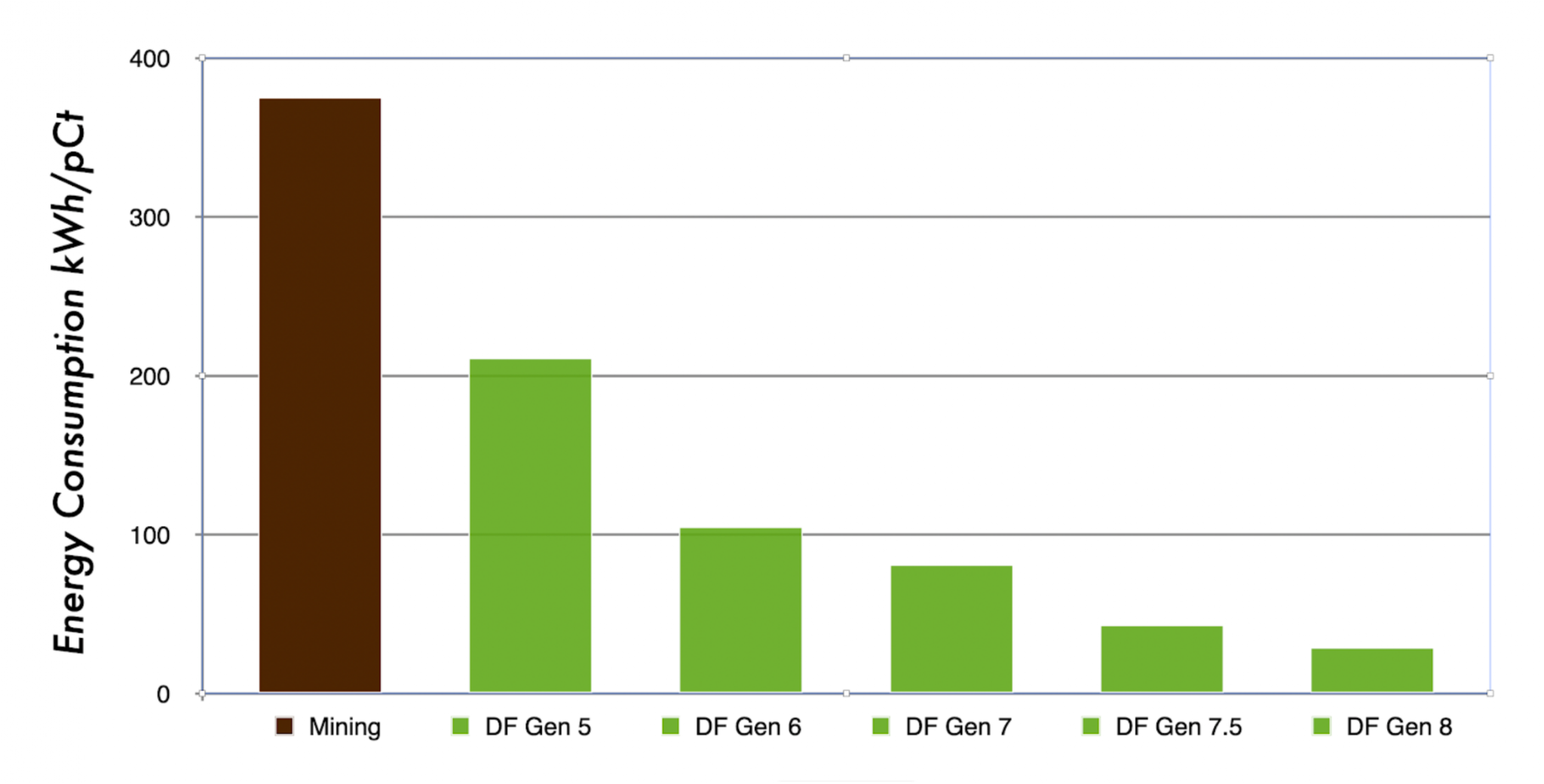
The chart above starts with the reference disclosed by the Natural Diamond Council’s TruCost study that S&P Global was paid to create for the energy required per polished carat for natural diamonds. (Note that the Ali reference in Bates (2019) warns specifically that mining companies generally do not give the full picture, not accounting for the costs of exploration and transportation to the often isolated mine sites.)
The sheer amount of energy involved being so high for mining speaks to the fact that mining is very hard work — it requires moving hundreds of tons of soil for the hope of finding some good carats, etc.
The chart then shows the earliest plasma reactor technology used in growing diamond in a lab had a technological capability of about twice as good an energy efficiency as the level of mining. Then though each subsequent reactor technology generation improved on this further, and today’s technology is more than ten times as efficient as what the TruCost study describes diamond mining requires. (Approximately half of this energy – or as little as 14kWh per carat with the most advanced generation of reactors – is used for the actual diamond growth.)
The Misleading Argyle Metric: The number touted often by the mining industry is the Australian Argyle mines at 7.5 kWh per carat. That’s significantly lower than the other mines — but the material produced in these mines tends to be lower quality rough as well. Primarily though, mining ended in 2020 with the mine in Western Australia completely shut down.
The Facts: High Carbon Emissions versus Renewable Power as Energy Used
Then the type of the energy used is very different of course: Mining in remote areas tends to require the use of Diesel generators whereas diamond foundries can be located in areas where they use solar power and other renewable sources of electricity.
This means that regardless of their energy consumption, foundry diamonds can be sustainably created whereas mined diamonds have a very large carbon footprint.
At lab producers using zero-emission energy, there are simply no emissions. So the carbon intensity factor is zero and thus the total product is zero as well. For illustration completeness, we include the chart showing how much less zero is than Diesel and Natural Gas emissions per energy unit: infinitely less so.
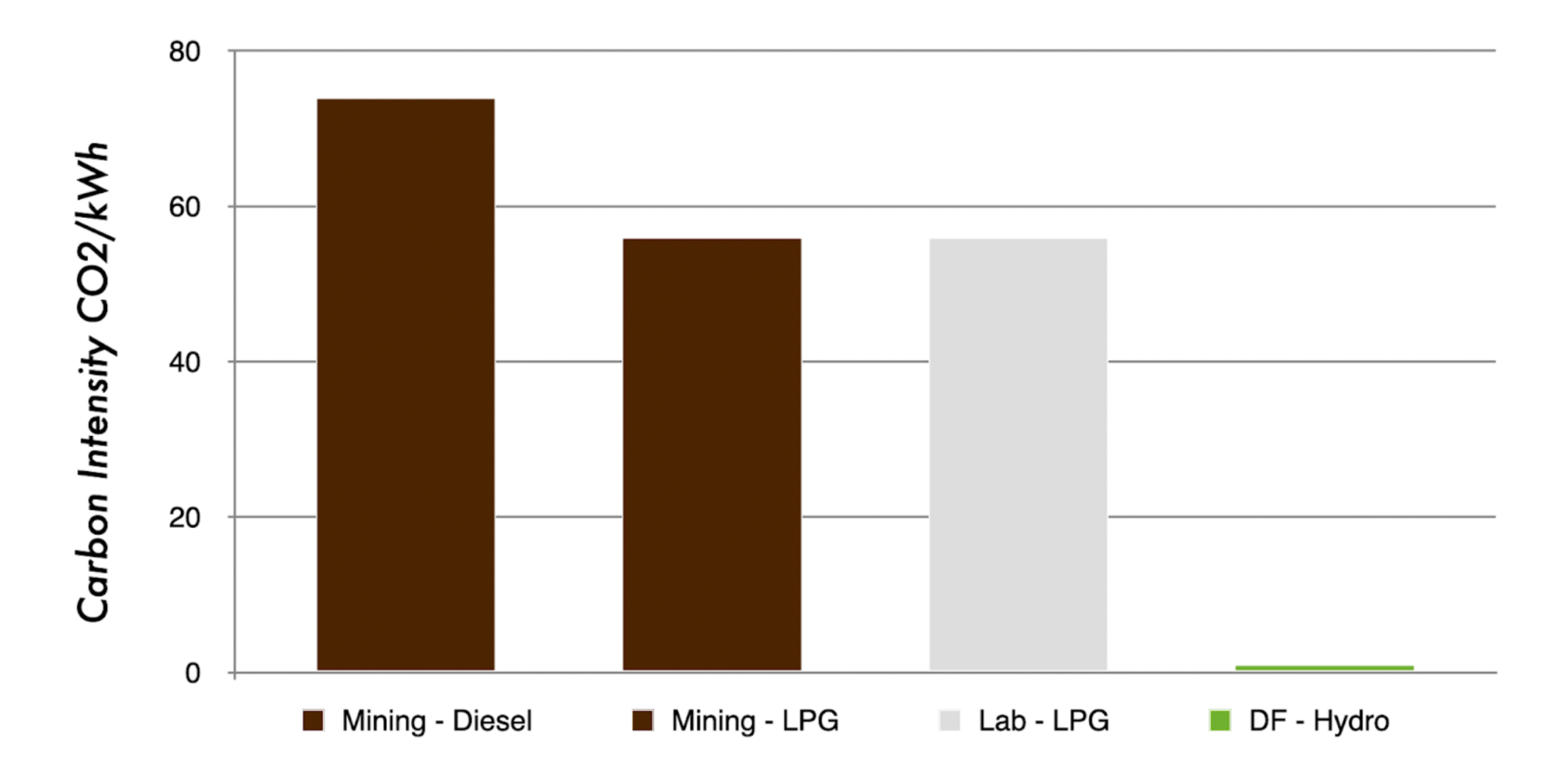
Zero is of course hard to beat with any number any day.
Could mining come anywhere close? Difficult because mines tend to exist in remote regions where renewable energy is hard to do. There might be press photos with wind energy farms in sub-zero Canadian regions. But the fact is, mining tends to use the worst kind of form of energy, diesel generators, with the worst kind of emissions per energy unit consumed.
So, hands-down a lab producer with renewable energy production would win; there is no chance that a miner could even compete.
The Fact: Total Environmental Footprint
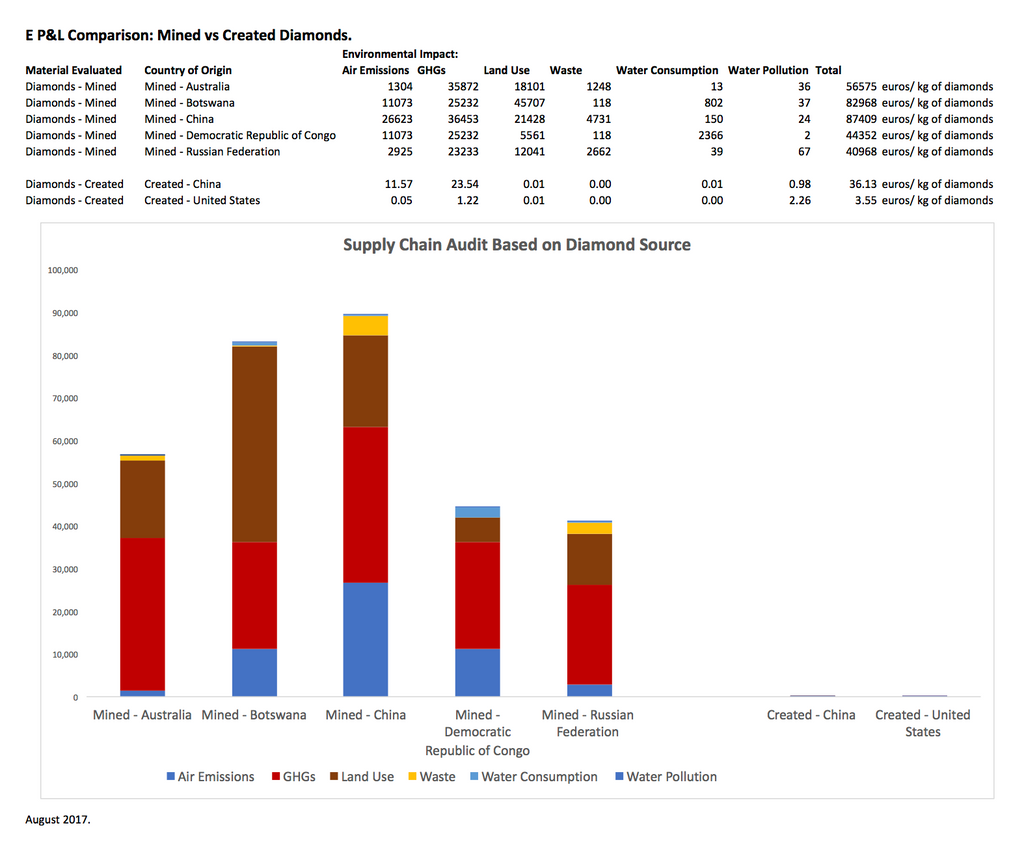
An independent audit conducted on the total environmental footprint of various diamond mines and foundry producers shows how vastly more environmental above-the-ground "mining" (in a foundry) is relative to underground mining:
Misleading Marketing by Diamond Miners
The diamond mining cartel represented by the Natural Diamond Council, now renamed to “The Diamond Collective”, basically lied through its teeth on environmental impact and successfully confused the public – in ways that even pro-mining advocates called quixotic.
Just as recently as 2021, the Natural Diamond Council / The Diamond Collective promoted overtly false claims with the help of “pay to play” paid outlets including Boston Consulting Group and S&P Global.
This follows an age old media strategy to seed confusion in public where the truth does not look good.
The natural diamond miners paid S&P Global to fabricate a false environmental impact study that achieved a media reach with its false information to more than 350 million consumers worldwide. It created a ton of confusion. Journalists to this day are confused themselves.
Among the numerous false claims, the S&P Global study claimed an amount of energy used for man-made production is very high – at a cost that would even exceed the market price for diamonds produced (!).
The reception of S&P Global’s TruCost study was weak to start with even among strident supporters of mined diamonds. For example, one industry analyst states how “comic” the study is:
And if the battles will be played on ecological fields, "natural diamonds" have practically no chances. A recent comic "study" conducted by Trucost ESG Analysis commissioned by DPA, during which synthetics producers were allegedly "caught" in generating some exorbitant CO2 emissions, clearly demonstrated the fighting power of advocates defending the position of natural diamonds. If DPA (now NDC) considers this as a serious argument, then the result of hostilities may be very sad for the “natural partisans”.
Similarly, Saleem Ali, Professor of Energy and the Environment, University of Delaware, stated: “Their estimates on greenhouse gas emissions and energy usage are very questionable. To claim that their carbon and energy footprint is less than synthetic . . . defies common sense.”
The U.S. Ruling: Diamond Miners Engaged in Misleading Marketing
In 2021, the National Advertising Division (NAD), the U.S. advertising industry’s independent self-regulatory body, found that diamond miners claiming that lab-grown diamonds cause three times the carbon emissions of mined diamonds was not backed by any reliable evidence. It also found that the broader implied claim of overall environmental superiority made by miners was unsupported by any evidence.
The decision determined that the carbon-emission comparison in the Trucost study contained “several flaws.”
First, it did not collect data directly from the leading lab-grown manufacturers and relied on “second and third-hand” information.
“[Mining c]ompanies providing information directly to Trucost had the ability and opportunity to vet such data while [lab-grown] manufacturers likely did not have any input on certain information as it was conveyed through second and third-hand sources, or the opportunity to correct for faulty assumptions,” the NAD said.
The NAD also found that the report used old data, and failed to note some lab-grown companies now use renewable energy. Its calculations also excluded “significant stages of the mining process,” including exploration, mine closure, and cutting and polishing, the group said.
In addition, “NAD was concerned that [such] claims conveyed a broader implied message about the overall environmental benefits of mined diamonds versus man-made diamonds, a message that was not supported,” it said.