
BCG has a significant and unusually substantive relationship with De Beers and the natural-diamond industry.
Boston Consulting Group is frequently cited as an authoritative source of research concerning the future of natural diamonds. Consumers and journalists evaluating such research should understand BCG's extensive commercial relationship with the natural-diamond industry—and particularly with De Beers.
The widely circulated 2024 BCG report, “The Future of the Natural Diamond Industry,” was not simply an independent BCG study about diamonds. It was a BCG–De Beers production under BCG’s name. De Beers itself directs readers to the “BCG report” from its investor/strategy materials, and De Beers' 2024 presentation reproduces BCG's analysis of natural-diamond demand, synthetic substitution, supply, scarcity and long-term pricing.
When BCG research about natural diamonds is cited, readers should therefore ask a simple question: Is this independent research about the natural-diamond industry—or research produced with, for, or in commercial collaboration with participants in that industry?
BCG now adds the world’s most thorough disclaimer to its reports – we wonder why – pointing out in fine print that it is commissioned by De Beers Group, that none of the info in it may be true or has been verified, that no reader should rely on any part of it, and that primarily BCG has no liability whatsoever and that any reader waives any and all rights reading the report:
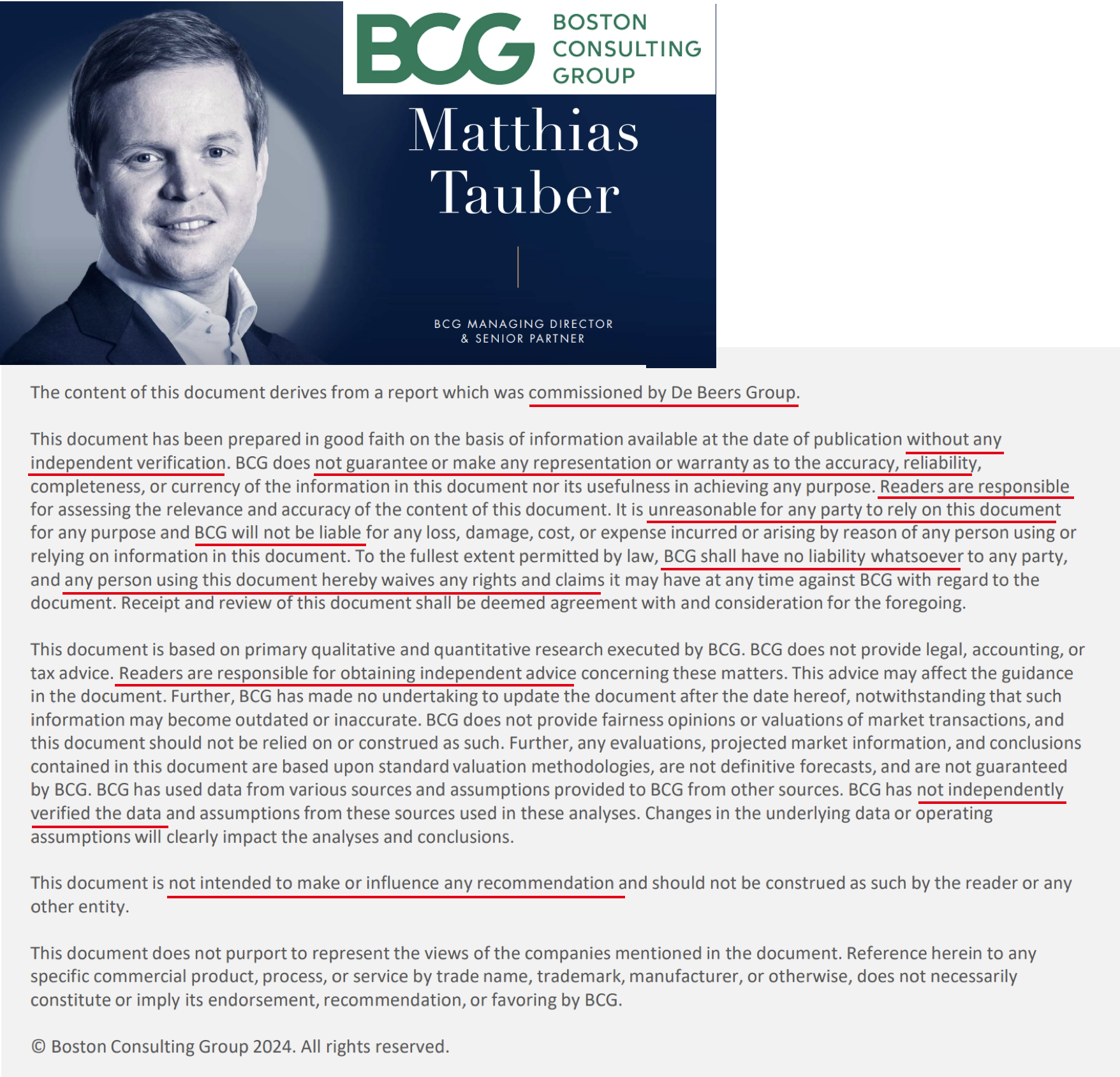
Individuals such as BCG Managing Directors Matthias Tauber and Adrian Rodrigues are the mercenary enablers – no longer hidden – of the mirror & deception in the diamond industry. They profit by saying anything their clients want them to say – and their legal counsel knows how to craft the world’s most comprehensive disclaimers.
Ironically, in Sept 2024, the BCG Boston Consulting Group formally admitted to corruption over the real blood diamonds effectively. Open Secrets — Unaccountable #39: BCG, Consultant to Kleptocrats
BCG has had substantial commercial relationships both in Angola and with De Beers; U.S. authorities found that misconduct by BCG personnel and an intermediary in Angola involved payments reaching government officials; BCG surrendered $14.424 million in resulting profits; and BCG later became deeply involved in developing the natural-diamond industry's provenance infrastructure and strategic narrative.
When BCG research is cited to consumers as evidence about the scarcity, sustainability, provenance or future value of natural diamonds, those commercial relationships are relevant context—and should be disclosed.
In 2024, the U.S. Department of Justice disclosed the results of an investigation into BCG's activities in Angola, one of the world's important diamond-producing countries. According to the DOJ, between approximately 2011 and 2017, BCG's Portugal office paid approximately $4.3 million in commissions to an agent in Angola to help BCG obtain business from Angolan government agencies.
The DOJ found that the agent shared a portion of those commissions with Angolan government officials associated with the Ministry of Economy to help BCG obtain contracts.
The misconduct went further. According to the DOJ, certain BCG employees took steps to conceal the arrangement when questions arose internally, including backdating contracts and falsifying the agent's purported work product.
BCG ultimately obtained eleven contracts with Angola's Ministry of Economy and another with the National Bank of Angola. Those contracts generated approximately $22.5 million of revenue and $14.424 million of profit for BCG.
BCG avoided indictment and conviction under the U.S. DOJ’s corporate-enforcement policy after considering BCG's voluntary self-disclosure, cooperation and remediation. As part of the resolution, BCG agreed to disgorge the entire $14.424 million in profits associated with the conduct.