
Myth 17
Boston Consulting Group (BCG), S&P Global, Bain & Co, GIA, CIBJO, JVC, JCK offer independent and unbiased information about and represent the diamond industry truthfully.
Truth
CIBJO: Natural Diamond Advocacy in Disguise
CIBJO is sometimes treated as though it were an independent international regulator of diamonds. It is not. CIBJO describes itself as the organization representing the jewellery industry from “mine to marketplace,” and its standards are voluntary industry standards.
That distinction matters in the debate over laboratory-grown diamonds.
The Natural Diamond Council—today The Diamond Collective—is itself a voting CIBJO member. De Beers executives have also occupied important positions inside CIBJO dealing with issues directly affecting the competition between mined and laboratory-grown diamonds.
A De Beers Consumer & Brands executive chaired CIBJO's Laboratory-Grown Diamond Committee. A senior De Beers executive chaired CIBJO's committee developing responsible-sourcing and sustainability terminology, while another De Beers sustainability executive served as committee lead. De Beers has also sponsored CIBJO's annual Congress.
CIBJO has simultaneously provided a forum for the natural-diamond industry to discuss how to stimulate consumer demand. It organized a session explicitly titled “Cultivating Demand for Natural Diamonds: How to Do It & Who Should Pay,” featuring senior representatives of De Beers and the Natural Diamond Council. More recently, CIBJO has hosted discussions about industry-wide strategies for strengthening natural diamonds.
This context is particularly important following CIBJO's 2026 decision to recommend that “synthetic” become the sole international descriptor for laboratory-grown diamonds—even though laboratory-grown diamonds have the same chemical composition, physical properties and crystal structure as mined diamonds and even though terms such as “laboratory-grown” remain legally accepted in markets including the United States.
CIBJO's Diamond Commission has gone further, advocating removal of “laboratory-grown” and “laboratory-created” from its preferred terminology and proposing that CIBJO explore restricting use of the familiar 4Cs grading framework to natural diamonds.
CIBJO is an industry organization whose membership, committees and policy discussions include—and in important instances have been led by—companies and organizations with substantial commercial interests in natural diamonds.
Its pronouncements concerning the terminology that competitors to natural diamonds should be permitted to use should therefore be understood for what they are: industry standards developed within an industry organization, not regulations issued by an independent government authority.
GIA + De Beers: Nearly a Century of Institutional Ties
GIA is commonly perceived as an independent authority standing apart from diamond miners. Its own historical records, however, reveal an unusually long and extensive relationship with De Beers—stretching almost to GIA's founding.
By approximately 1933, a director of De Beers and Affiliated Mines, H.T. Dickinson, was serving on GIA's Advisory Board. In other words, a De Beers director was advising GIA on its diamond curriculum within roughly two years of GIA's founding.
According to GIA's own historical account, “Beginning in 1940, GIA collaborated with De Beers to create advertising designed to stimulate an interest in diamonds.”
De Beers also supplied diamonds used in GIA's education. It provided GIA's Oppenheimer Student Collection beginning in 1938, donated 1,500 carats of rough diamonds in 1955, and made another major donation of diamond crystals in 1966 to support GIA's teaching of diamond grading and appraisal. GIA today recognizes De Beers among donors that have cumulatively contributed between $500,000 and $999,999 in non-cash gifts.
The relationship extended to marketing. GIA's own history states that, beginning in 1940, “GIA collaborated with De Beers to create advertising designed to stimulate an interest in diamonds.” De Beers' U.S. advertising organization subsequently helped teach American jewelers how to communicate GIA's emerging 4Cs framework to consumers.
The two institutions then jointly addressed the lab grown diamond “threat”. The relationship later became more deeply scientific. A former De Beers Diamond Research Laboratory researcher, D. Vincent Manson, became GIA's Director of Research in 1976 and established GIA's expanded research facility. De Beers later supplied GIA researchers with experimental laboratory-grown diamonds for landmark identification studies. GIA itself has described De Beers as having “worked closely with GIA” on synthetic-diamond research.
The institutional connections continue today. In January 2024, former De Beers CEO François Delage joined GIA's Board of Governors. Delage had been CEO of De Beers Jewellers, 2009–2020 and CEO of De Beers' Forevermark diamond brand.
GIA and De Beers are not institutions whose paths merely happen to cross. Their cooperation spans more than 90 years and has included governance advice, diamond donations, consumer marketing, education, personnel, scientific research, laboratory equipment, provenance infrastructure and, today, a shared corporate investment.
BCG Boston Consulting Group: The Mercenary Enabler
BCG has a significant and unusually substantive relationship with De Beers and the natural-diamond industry.
Boston Consulting Group is frequently cited as an authoritative source of research concerning the future of natural diamonds. Consumers and journalists evaluating such research should understand BCG's extensive commercial relationship with the natural-diamond industry—and particularly with De Beers.
The widely circulated 2024 BCG report, “The Future of the Natural Diamond Industry,” was not simply an independent BCG study about diamonds. It was a BCG–De Beers production under BCG’s name. De Beers itself directs readers to the “BCG report” from its investor/strategy materials, and De Beers' 2024 presentation reproduces BCG's analysis of natural-diamond demand, synthetic substitution, supply, scarcity and long-term pricing.
When BCG research about natural diamonds is cited, readers should therefore ask a simple question: Is this independent research about the natural-diamond industry—or research produced with, for, or in commercial collaboration with participants in that industry?
BCG now adds the world’s most thorough disclaimer to its reports – we wonder why – pointing out in fine print that it is commissioned by De Beers Group, that none of the info in it may be true or has been verified, that no reader should rely on any part of it, and that primarily BCG has no liability whatsoever and that any reader waives any and all rights reading the report:
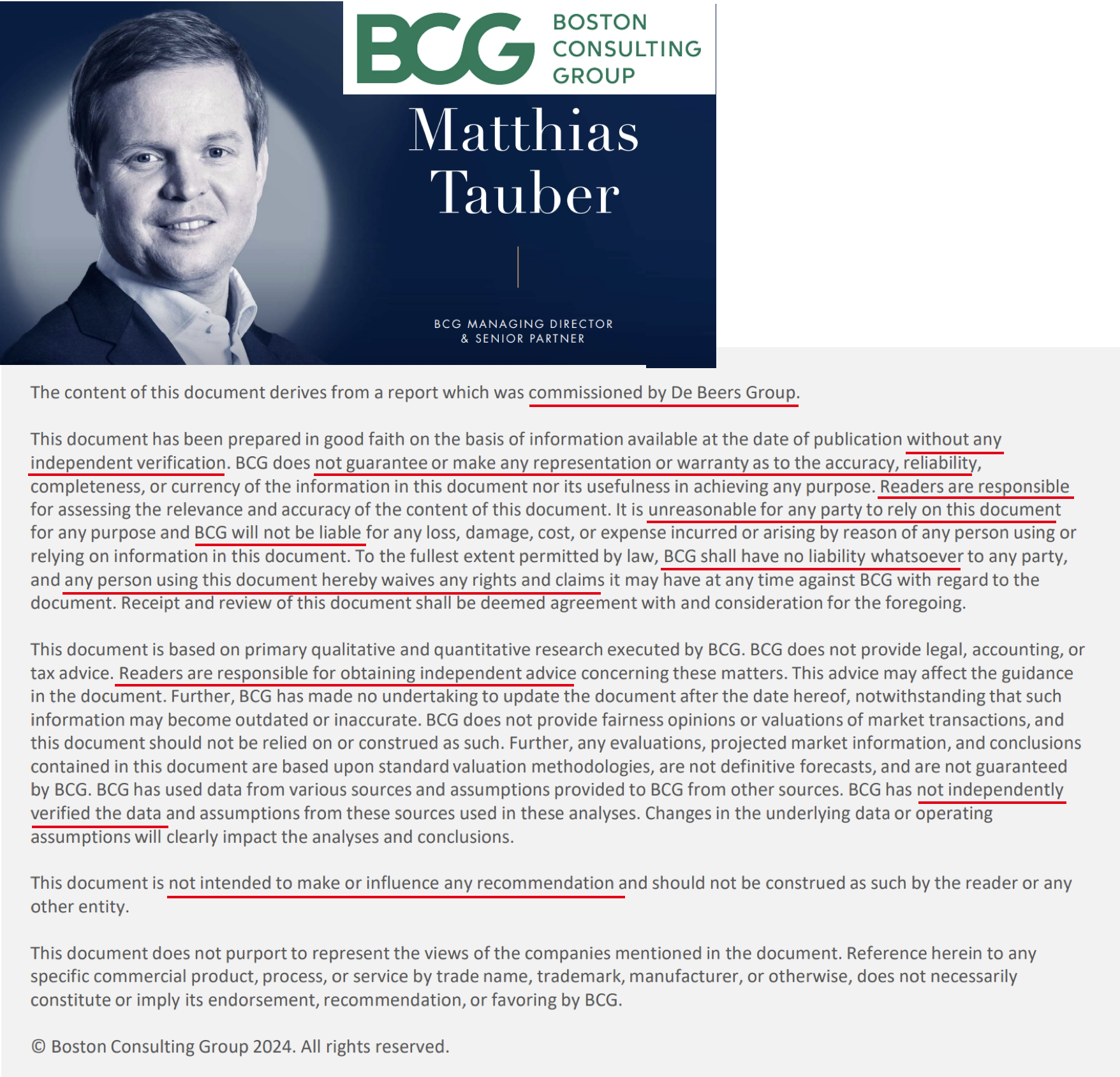
Individuals such as BCG Managing Directors Matthias Tauber and Adrian Rodrigues are the mercenary enablers – no longer hidden – of the mirror & deception in the diamond industry. They profit by saying anything their clients want them to say – and their legal counsel knows how to craft the world’s most comprehensive disclaimers.
Ironically, in Sept 2024, the BCG Boston Consulting Group formally admitted to corruption over the real blood diamonds effectively. Open Secrets — Unaccountable #39: BCG, Consultant to Kleptocrats
BCG has had substantial commercial relationships both in Angola and with De Beers; U.S. authorities found that misconduct by BCG personnel and an intermediary in Angola involved payments reaching government officials; BCG surrendered $14.424 million in resulting profits; and BCG later became deeply involved in developing the natural-diamond industry's provenance infrastructure and strategic narrative.
When BCG research is cited to consumers as evidence about the scarcity, sustainability, provenance or future value of natural diamonds, those commercial relationships are relevant context—and should be disclosed.
In 2024, the U.S. Department of Justice disclosed the results of an investigation into BCG's activities in Angola, one of the world's important diamond-producing countries. According to the DOJ, between approximately 2011 and 2017, BCG's Portugal office paid approximately $4.3 million in commissions to an agent in Angola to help BCG obtain business from Angolan government agencies.
The DOJ found that the agent shared a portion of those commissions with Angolan government officials associated with the Ministry of Economy to help BCG obtain contracts.
The misconduct went further. According to the DOJ, certain BCG employees took steps to conceal the arrangement when questions arose internally, including backdating contracts and falsifying the agent's purported work product.
BCG ultimately obtained eleven contracts with Angola's Ministry of Economy and another with the National Bank of Angola. Those contracts generated approximately $22.5 million of revenue and $14.424 million of profit for BCG.
BCG avoided indictment and conviction under the U.S. DOJ’s corporate-enforcement policy after considering BCG's voluntary self-disclosure, cooperation and remediation. As part of the resolution, BCG agreed to disgorge the entire $14.424 million in profits associated with the conduct.
Bain & Company
For more than a decade, reports from Bain & Company have been widely cited by journalists, investors and the diamond industry as authoritative analysis of natural-diamond supply, demand, pricing, scarcity and laboratory-grown diamonds.
Bain & Company produced its widely read diamond industry reports often in association with the Antwerp World Diamond Centre. These reports provided a seeming “third party”, “independent” view of De Beers’ messaging of diamond supply scarcity, etc. It concludes “New natural diamond supply remains limited.”
Bain was not merely an outside observer of the diamond industry. It had previously been hired by De Beers to help fundamentally redesign De Beers itself.
A forecast prepared for the natural-diamond industry's principal trading organization should not automatically be presented to consumers as though it were independent academic evidence about the future scarcity or investment value of natural diamonds.
S&P Global. Paid by Natural Diamond Council to Fabricate A Misleading Study with Comical Errors and Bad Faith
The Natural Diamond Council’s Trucost study that it paid S&P Global, the purveyor of the S&P 500 index, to fabricate contains numerous egregious errors including:
- The main sources cited by S&P Global’s study are a jewelry journalist and a jeweler who each quote hearsay, not any experts in environmental impact assessment of semiconductor grade manufacturing.
- None of the largest producers – neither Diamond Foundry nor Natural Diamond Council member De Beers’ own lab diamond unit – were asked for data about the modern state of diamond manufacturing. Instead, the study references decades-old technology from industry pioneers no longer even in business.
- The study contains made-up math including averaging energy consumption data from no longer existing producers, averaging over the number of citations rather than production volume, and omitting data from the most innovative and largest producers.
- The study omits that leading producers like Diamond Foundry use hydropower with zero emissions (and on top of that additionally offset carbon as if it were not).
The Trucost study cites articles by Rob Bates and Jason Payne. We love both Rob and Jason – as a jewelry trade journalist and a jeweler, respectively. But they are not a qualified “source” for semiconductor grade manufacturing technology and its environmental impact.
Rob Bates’ article refers to hearsay, quoting one “grower” who says he heard from another grower that at some point in the past some amount of energy was used. Jason Payne is quoted on numbers that are similarly just hearsay.
The two most substantive reports referenced are an ABN Amro report written in 2011 and a “working paper” from Saleem Ali.
The ABN Amro report refers to the first lab-grown diamond pioneers Gemesis and Apollo, long out of business for a reason. Their technology was first-generation, created two decades ago, true laboratory style. The Saleem Ali working paper cites the same two pioneers, Apollo and Gemesis, with numbers of 28kWh per carat and 20kWh per carat respectively. The TruCost study conveniently omits these key data points when “averaging” the available data points to 727kWh.
S&P Global made no inquiry with Diamond Foundry and not with its own key member De Beers’ own subsidiary Element Six. (De Beers is a part of the Natural Diamond Council / the Diamond Collective – they commission the study yet do not get your own tech unit to contribute data?)
S&P Global uses false math to average the energy consumption numbers from producers that no longer exist while omitting the metrics from the most innovative and largest producers.
The Natural Diamond Council and S&P Global make a major marketing statement with an impact study based on hearsay from jewelers, decades-old technology data, and flaky math.
For precise detail, here is the Appendix data that the entire S&P Global study paid for by the Natural Diamond Council boils down to:
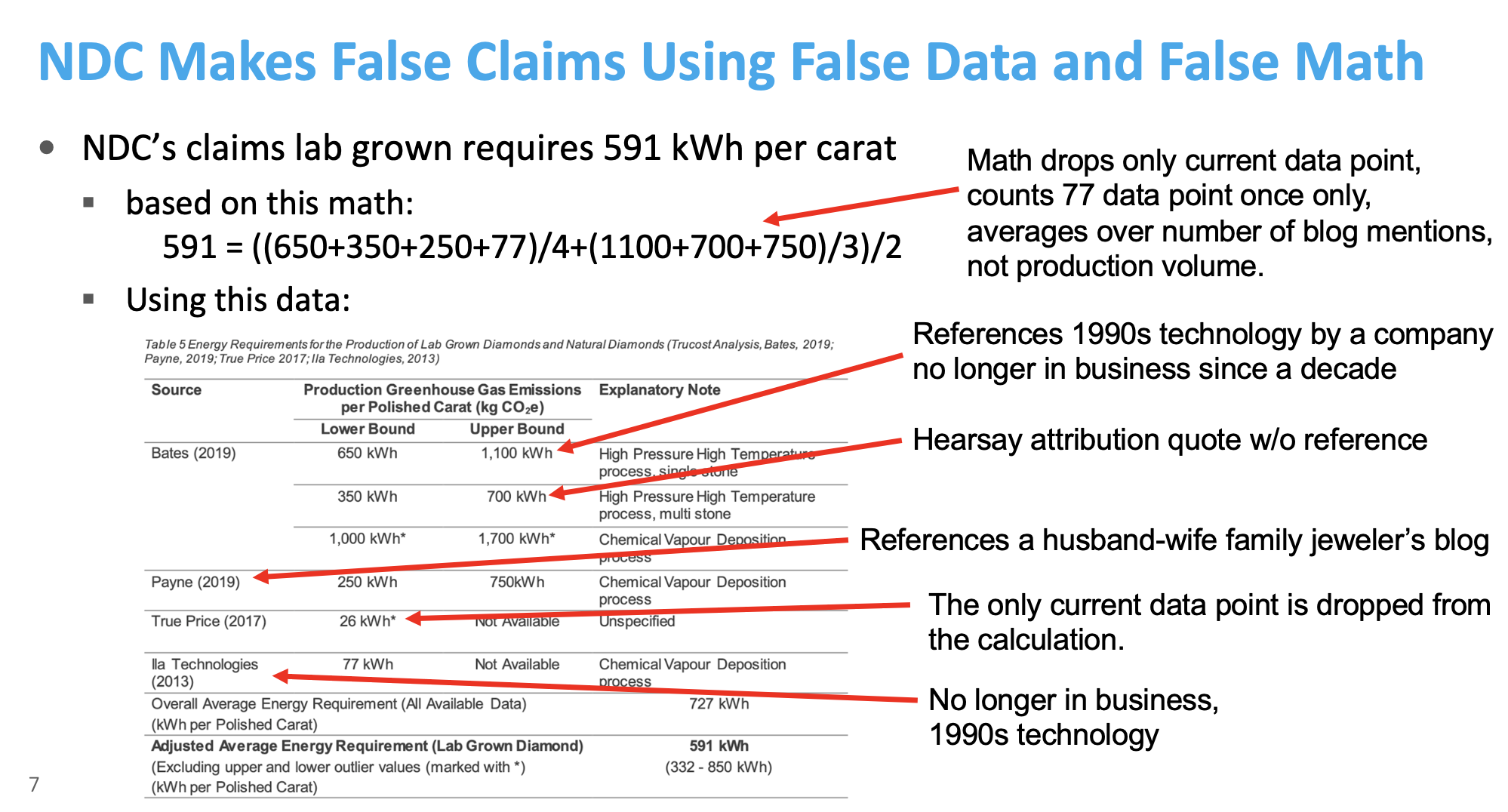
Of this table, Bates (2019) is a jewelry article that 1.) references the 650-1,100kWh number from hearsay and without attribution but specifically points out that this refers to outdated technology and that modern presses may achieve 350-700kWh; 2.) references the 60–120 kWh per rough carat for CVD technology, again from hearsay and without attribution, and somehow extrapolates this to 1,000–1,700 kWh per polished carat even though the factor between polished and rough is at most a factor of four, certainly not more than 16.
Payne (2019) quotes 250kW from hearsay without further attribution.
True Price references 26kWh as a reference to a real producer, albeit one decades ago and no longer in business. (Newer technology would be more energy efficient.)
S&P Global now proceeds to include the outdated high numbers, disregard the only actual (and smallest) reference number, and average this into 591kWh by omitting the low IIa number from the Upper Bounds and counting the high Payne/Bates numbers twice.
If it weren’t so egregious, we would actually find it quite funny the extent to which S&P Global fudges data and math. This would be like Microsoft creating a billboard advertising the Microsoft phone as one million times faster than Apple’s -- without disclosing that the one million factor is relative to an Apple II computer instead of the iPhone on the market today and that Apple II data comes from averaging blog mentions, not any real data.
Of course, there is nothing funny about bad faith and being misleading and deceptive.
The U.S. Ruling: Natural Diamond Council Engaged in Misleading Marketing with TruCost Study Fabricated by S&P Global
The National Advertising Division (NAD), the U.S. advertising industry’s independent self-regulatory body, in 2021 found that diamond miners claiming that lab-grown diamonds cause three times the carbon emissions of mined diamonds was not backed by any reliable evidence. It also found that the broader implied claim of overall environmental superiority made by miners was unsupported by any evidence.
The decision determined that the carbon-emission comparison in the Trucost study contained “several flaws.”
First, it did not collect data directly from the leading lab-grown manufacturers and relied on “second and third-hand” information.
“[Mining c]ompanies providing information directly to Trucost had the ability and opportunity to vet such data while [lab-grown] manufacturers likely did not have any input on certain information as it was conveyed through second and third-hand sources, or the opportunity to correct for faulty assumptions,” the NAD said.
The NAD also found that the report used old data, and failed to note some lab-grown companies now use renewable energy. Its calculations also excluded “significant stages of the mining process,” including exploration, mine closure, and cutting and polishing, the group said.
In addition, “NAD was concerned that [such] claims conveyed a broader implied message about the overall environmental benefits of mined diamonds versus man-made diamonds, a message that was not supported,” it said.