
The Natural Diamond Council’s Trucost study that it paid S&P Global, the purveyor of the S&P 500 index, to fabricate contains numerous egregious errors including:
- The main sources cited by S&P Global’s study are a jewelry journalist and a jeweler who each quote hearsay, not any experts in environmental impact assessment of semiconductor grade manufacturing.
- None of the largest producers – neither Diamond Foundry nor Natural Diamond Council member De Beers’ own lab diamond unit – were asked for data about the modern state of diamond manufacturing. Instead, the study references decades-old technology from industry pioneers no longer even in business.
- The study contains made-up math including averaging energy consumption data from no longer existing producers, averaging over the number of citations rather than production volume, and omitting data from the most innovative and largest producers.
- The study omits that leading producers like Diamond Foundry use hydropower with zero emissions (and on top of that additionally offset carbon as if it were not).
The Trucost study cites articles by Rob Bates and Jason Payne. We love both Rob and Jason – as a jewelry trade journalist and a jeweler, respectively. But they are not a qualified “source” for semiconductor grade manufacturing technology and its environmental impact.
Rob Bates’ article refers to hearsay, quoting one “grower” who says he heard from another grower that at some point in the past some amount of energy was used. Jason Payne is quoted on numbers that are similarly just hearsay.
The two most substantive reports referenced are an ABN Amro report written in 2011 and a “working paper” from Saleem Ali.
The ABN Amro report refers to the first lab-grown diamond pioneers Gemesis and Apollo, long out of business for a reason. Their technology was first-generation, created two decades ago, true laboratory style. The Saleem Ali working paper cites the same two pioneers, Apollo and Gemesis, with numbers of 28kWh per carat and 20kWh per carat respectively. The TruCost study conveniently omits these key data points when “averaging” the available data points to 727kWh.
S&P Global made no inquiry with Diamond Foundry and not with its own key member De Beers’ own subsidiary Element Six. (De Beers is a part of the Natural Diamond Council / the Diamond Collective – they commission the study yet do not get your own tech unit to contribute data?)
S&P Global uses false math to average the energy consumption numbers from producers that no longer exist while omitting the metrics from the most innovative and largest producers.
The Natural Diamond Council and S&P Global make a major marketing statement with an impact study based on hearsay from jewelers, decades-old technology data, and flaky math.
For precise detail, here is the Appendix data that the entire S&P Global study paid for by the Natural Diamond Council boils down to:
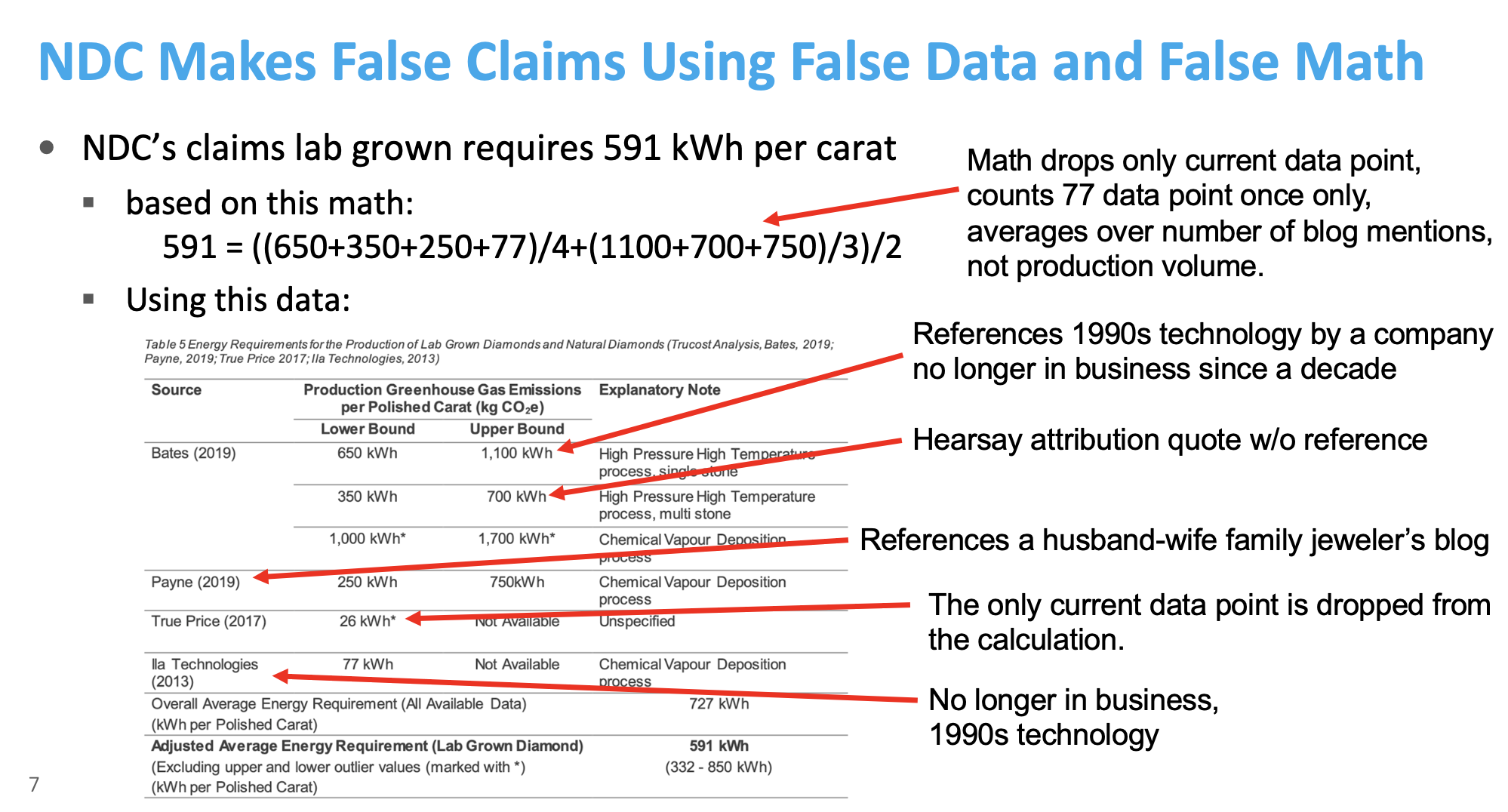
Of this table, Bates (2019) is a jewelry article that 1.) references the 650-1,100kWh number from hearsay and without attribution but specifically points out that this refers to outdated technology and that modern presses may achieve 350-700kWh; 2.) references the 60–120 kWh per rough carat for CVD technology, again from hearsay and without attribution, and somehow extrapolates this to 1,000–1,700 kWh per polished carat even though the factor between polished and rough is at most a factor of four, certainly not more than 16.
Payne (2019) quotes 250kW from hearsay without further attribution.
True Price references 26kWh as a reference to a real producer, albeit one decades ago and no longer in business. (Newer technology would be more energy efficient.)
S&P Global now proceeds to include the outdated high numbers, disregard the only actual (and smallest) reference number, and average this into 591kWh by omitting the low IIa number from the Upper Bounds and counting the high Payne/Bates numbers twice.
If it weren’t so egregious, we would actually find it quite funny the extent to which S&P Global fudges data and math. This would be like Microsoft creating a billboard advertising the Microsoft phone as one million times faster than Apple’s -- without disclosing that the one million factor is relative to an Apple II computer instead of the iPhone on the market today and that Apple II data comes from averaging blog mentions, not any real data.
Of course, there is nothing funny about bad faith and being misleading and deceptive.
The U.S. Ruling: Natural Diamond Council Engaged in Misleading Marketing with TruCost Study Fabricated by S&P Global
The National Advertising Division (NAD), the U.S. advertising industry’s independent self-regulatory body, in 2021 found that diamond miners claiming that lab-grown diamonds cause three times the carbon emissions of mined diamonds was not backed by any reliable evidence. It also found that the broader implied claim of overall environmental superiority made by miners was unsupported by any evidence.
The decision determined that the carbon-emission comparison in the Trucost study contained “several flaws.”
First, it did not collect data directly from the leading lab-grown manufacturers and relied on “second and third-hand” information.
“[Mining c]ompanies providing information directly to Trucost had the ability and opportunity to vet such data while [lab-grown] manufacturers likely did not have any input on certain information as it was conveyed through second and third-hand sources, or the opportunity to correct for faulty assumptions,” the NAD said.
The NAD also found that the report used old data, and failed to note some lab-grown companies now use renewable energy. Its calculations also excluded “significant stages of the mining process,” including exploration, mine closure, and cutting and polishing, the group said.
In addition, “NAD was concerned that [such] claims conveyed a broader implied message about the overall environmental benefits of mined diamonds versus man-made diamonds, a message that was not supported,” it said.